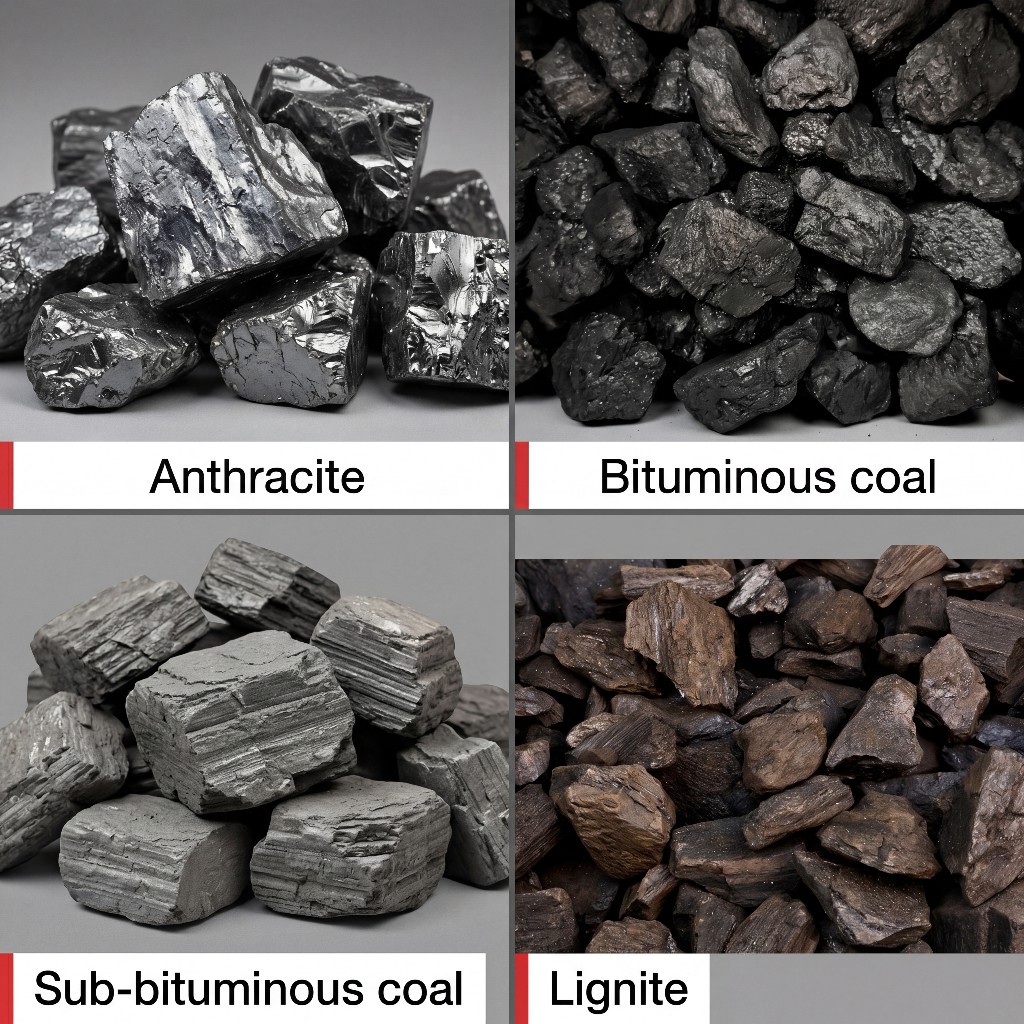
Coal is a naturally occurring fossil fuel formed from ancient plant matter compressed over millions of years under conditions of heat and pressure. Its quality and commercial classification is determined primarily by carbon content, calorific value (energy density), and moisture content — properties that vary widely across geological age and depositional history.
The Four Commercial Ranks
Hibernia General supplies all four principal coal ranks:
Anthracite is the highest-rank coal: hardest, blackest, with carbon content 86–97% and the highest energy density of any coal type. It burns cleanly with a short blue flame and very little smoke — preferred for residential and small-scale industrial heating where emissions matter.
Bituminous coal is the most abundant and commercially important rank globally. It is sub-classified into thermal (steam) coal, used primarily for electricity generation, and coking (metallurgical) coal — the essential reductant in steel blast furnaces, where its specific caking properties allow it to be transformed into coke.
Sub-Bituminous coal sits between Bituminous and Lignite. It is the most widely consumed coal globally by tonnage, representing roughly 30% of world reserves. Lower carbon content than Bituminous but cleaner than Lignite — suitable for utility boilers and cement kilns.
Lignite (Brown Coal) is the lowest rank, geologically the youngest (~60 million years), and the highest in moisture content. Its lower energy density makes it economical only when burned close to the mine, but global reserves are vast.
Quality Documentation
Every shipment is accompanied by full proximate analysis (moisture, ash, volatile matter, fixed carbon), ultimate analysis (C, H, N, S, O), calorific value (GCV/NCV), sulfur content, and ash composition. SGS or independent surveyor inspection arrangeable at loading port.
Anthracite
The highest quality coal — hard, lustrous black, with the highest carbon content and energy density of any coal rank. Burns with very little smoke and a short blue flame.
- Carbon 86 – 97%
- Calorific Value 32 – 33 MJ/kg
- Moisture 7 – 10%
- Ash 5 – 10%
Bituminous Coal
The most abundant coal type. Dense, black, and brittle with relatively low moisture. Primary fuel for electricity generation and metallurgical (coking) coal for steel production.
- Carbon 76 – 86%
- Calorific Value 23 – 33 MJ/kg
- Moisture 8 – 18%
- Variants Coking / Thermal
Sub-Bituminous Coal
Grey-black to dark brown coal representing an intermediate rank. The most widely used coal globally (30% of world reserves). Lower carbon than bituminous but cleaner than lignite.
- Carbon 70 – 76%
- Calorific Value 18 – 23 MJ/kg
- Moisture 18 – 38%
- Sulfur Lower
Lignite (Brown Coal)
The lowest rank of coal, young in geological age (~60 million years). Brown and crumbly with highest moisture and lowest calorific value. Used in nearby power plants due to transport economics.
- Carbon 65 – 70%
- Calorific Value 17 – 18 MJ/kg
- Moisture 35 – 55%
- Volatile High
| Property | Anthracite | Bituminous | Sub-Bituminous | Lignite |
|---|---|---|---|---|
| Carbon Content (%) | 86 – 97 | 76 – 86 | 70 – 76 | 65 – 70 |
| Calorific Value (MJ/kg) | 32 – 33 | 23 – 33 | 18 – 23 | 17 – 18 |
| Moisture (% as received) | 7 – 10 | 8 – 18 | 18 – 38 | 35 – 55 |
| Volatile Content (% dry) | 3 – 14 | 14 – 46 | 42 – 53 | 53 – 63 |
| Typical Ash Content | 5 – 15% | 5 – 20% | 5 – 15% | 10 – 30% |
| Typical Sulfur Content | 0.5 – 1% | 0.5 – 3% | 0.3 – 1.5% | 0.3 – 2% |
| Geological Age (approx.) | 350M yrs | 300M yrs | 251M yrs | 60M yrs |
| HGI (Hardgrove Grindability) | 30 – 50 | 40 – 75 | 40 – 50 | 40 – 50 |
| Form | Lump · Coarse · Fine · Pulverised — as required | |||
| Packaging | Bulk vessel · Bulk truck · 1MT FIBC jumbo bags | |||
Specifications are typical ranges; precise values vary by origin (Indonesia, South Africa, Russia, Colombia, Australia). Origin-specific COA provided.
Packaging & Form
- Bulk vessel Standard
- 1 MT FIBC bags Container loads
- Lump / Coarse 0 – 50 mm
- Pulverised 200 mesh
- Min. parcel 5,000 MT
Trade Terms
- FOB Source Port ✓
- CIF Destination ✓
- CFR Destination ✓
- L/C at sight Standard
- SBLC / DLC Acceptable
Documentation
- Proximate Analysis Provided
- Ultimate Analysis Provided
- Calorific Value GCV/NCV
- Sulfur Content Per shipment
- SGS Inspection On request
Certificate of Analysis — Sample
Coal (Bituminous Thermal) · Batch: HG-COAL-2025-0114| Parameter | Result | Spec | Unit |
|---|---|---|---|
| Gross Calorific Value | 5850 | 5500 – 6200 | kcal/kg |
| Ash Content | 12.5 | ≤ 15 | % |
| Moisture | 8.2 | ≤ 10 | % |
| Volatile Matter | 28.4 | 25 – 35 | % |
| Sulphur (S) | 0.6 | ≤ 1.0 | % |
Illustrative sample. Request COA →