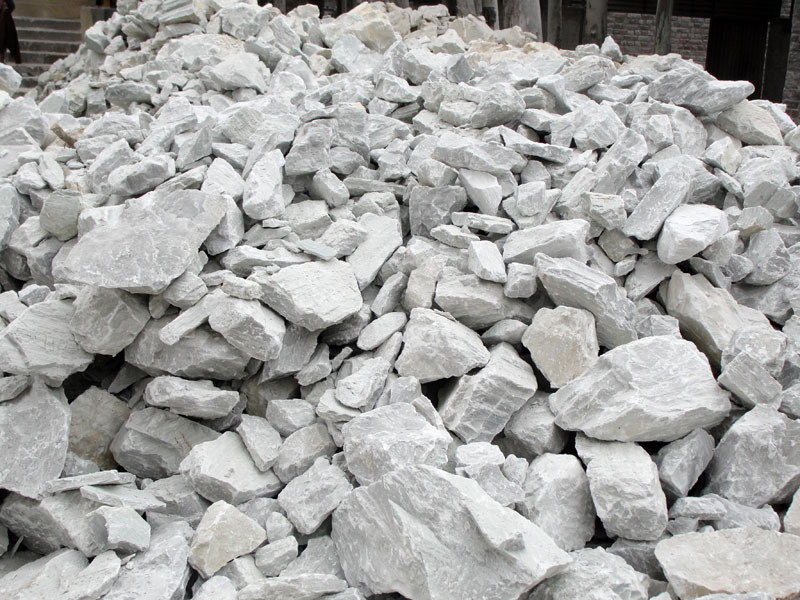
Natural gypsum — chemically calcium sulfate dihydrate (CaSO₄·2H₂O) — is a soft sulfate mineral with one of the most diverse industrial application profiles of any commodity. From cement set-retarder to plasterboard, from agricultural soil amendment to dental casting, gypsum is everywhere construction, agriculture and industry intersect.
Critical Role in Cement Manufacturing
The single largest use of gypsum globally is in Portland cement production. Roughly 5% gypsum is added during the clinker grinding stage, where it dissolves into the cement and reacts with the highly aggressive C₃A (tricalcium aluminate) phase to prevent flash-setting. Without gypsum, freshly mixed concrete would harden in minutes — making the material unusable for construction.
Plaster & Construction
When natural gypsum is calcined at controlled temperatures (around 150 °C), it loses three-quarters of its chemical water to form calcium sulfate hemihydrate (CaSO₄·½H₂O) — better known as plaster of Paris. This material reabsorbs water when mixed with water for use, forming a quick-setting plaster used in drywall (gypsum board), interior plaster finishes, decorative mouldings, and prefabricated construction elements.
Agricultural Gypsum
Natural gypsum is also an exceptional soil amendment. It provides plants with 23% calcium and 18% sulfur, improves drainage in heavy clay soils by promoting flocculation, and neutralises toxic aluminium in acidic soils. Unlike lime, gypsum does not raise soil pH — making it suitable for calcium-loving crops grown in soils that already have adequate pH.
Cement Grade (Rock)
High-purity raw gypsum rock used as a set-retarder additive in Portland cement grinding mills. Lumps or crushed form, shipped in bulk vessels.
- CaSO₄·2H₂O ≥ 80%
- Form Rock / Lump
- Size 0 – 50 mm
- Moisture ≤ 5%
Plaster / Construction Grade
Finely calcined gypsum powder (hemi-hydrate, CaSO₄·½H₂O) for interior plaster, stucco, drywall manufacturing and prefabricated construction elements.
- CaSO₄·2H₂O ≥ 85%
- Whiteness ≥ 85%
- Fineness 80 – 200 mesh
- Moisture ≤ 2%
Agricultural Grade
Natural gypsum as a soil amendment — provides 23% calcium and 18% sulfur, improves drainage in clay soils, and neutralises aluminium toxicity.
- Ca content ~ 23%
- S content ~ 18%
- Form Granular / Powder
- Solubility Slow-release
| Parameter | Cement Grade | Plaster Grade | Agricultural |
|---|---|---|---|
| CaSO₄·2H₂O | ≥ 80% | ≥ 85% | ≥ 75% |
| CaO | 28 – 32% | 30 – 33% | 27 – 30% |
| SO₃ | 38 – 42% | 40 – 44% | 35 – 42% |
| SiO₂ | ≤ 5% | ≤ 3% | ≤ 8% |
| Al₂O₃ | ≤ 1.5% | ≤ 1% | ≤ 2% |
| Fe₂O₃ | ≤ 0.5% | ≤ 0.3% | ≤ 1% |
| MgO | ≤ 1% | ≤ 0.5% | ≤ 1.5% |
| Moisture | ≤ 5% | ≤ 2% | ≤ 8% |
| Form | Rock / Lump | Powder | Granular / Powder |
| Packaging | Bulk | 25kg bags / Bulk | 25kg / 50kg bags |
Chemical analysis (XRF) provided with every shipment. Custom particle size ranges available for plaster grade on request.
Packaging Options
- Bulk vessel Cement grade
- 25 kg bags Plaster grade
- 50 kg bags Agricultural
- 1 MT jumbo bags Available
Trade Terms
- FOB Dubai ✓
- CIF Destination ✓
- CFR Destination ✓
- L/C, T/T Accepted
Documentation
- Certificate of Analysis Every batch
- XRF Report Provided
- Bill of Lading Original
- Certificate of Origin Provided
Certificate of Analysis — Sample
Gypsum Stone (Cement Grade) · Batch: HG-GYPSUM-2025-0203| Parameter | Result | Spec | Unit |
|---|---|---|---|
| CaSO₄·2H₂O | 91.2 | ≥ 90 | % |
| SO₃ Content | 40.1 | 38 – 42 | % |
| Moisture | 0.4 | ≤ 0.5 | % |
| Crystal Water | 20.8 | ≥ 20 | % |
Illustrative sample. Request COA →